

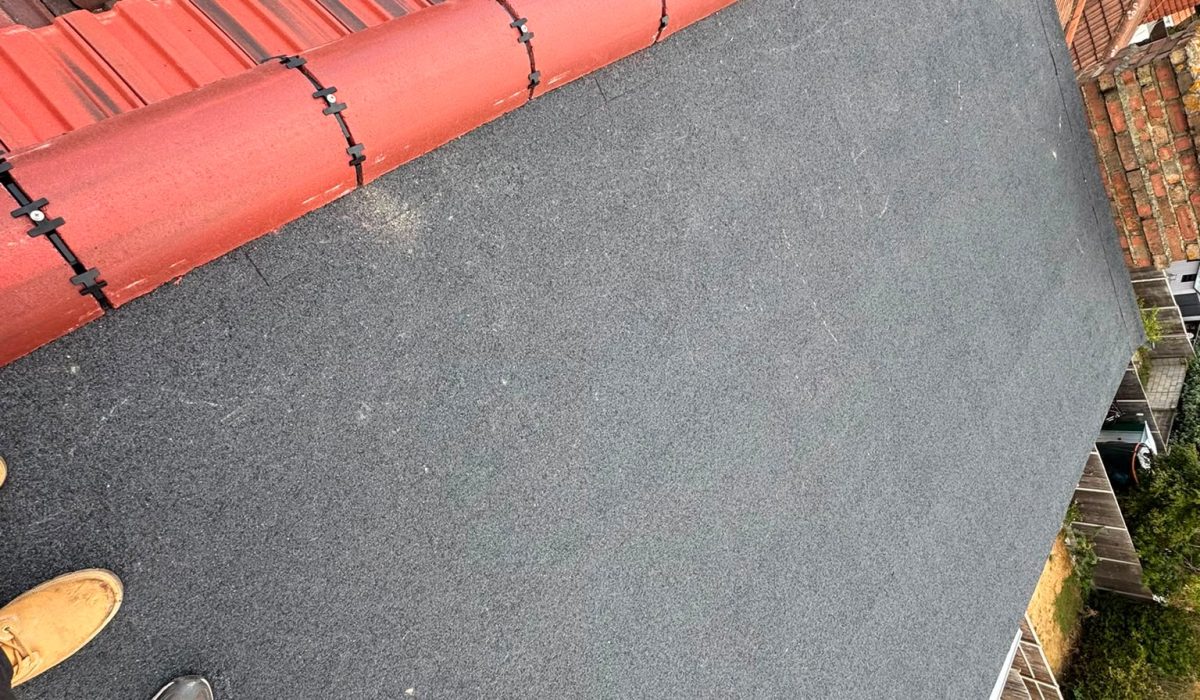
Flat roofs are everywhere in London: on rear extensions, garages, dormers, bay windows and many terraces and mansion blocks. They have no pitch to shed water, so the details matter more than anything. Choosing the right system, and the right installer, is the difference between a roof that lasts for decades and one that leaks within a few years.
Three-layer torch-on felt
A multi-layer bitumen system: a base layer, an intermediate layer and a mineral-finished cap sheet, heat-bonded to form one continuous waterproof surface. It is durable, easy to repair and well suited to larger roofs. It is our most common specification.
- Strengths: robust, repairable, proven
- Watch for: needs skilled installation with correct upstands and flashings
- Suits: extensions, garages and larger flat roofs
GRP fibreglass
GRP (glass-reinforced plastic) is a liquid-applied system: glass matting, resin and a UV-stable top coat form a seamless, jointless surface. It suits small roofs, balconies and awkward shapes with many details.
- Strengths: seamless, tough, good for small and complex roofs
- Watch for: the top coat is essential, and the substrate must be dry and sound
- Suits: balconies, small extensions and roofs with lots of corners
We have been called in to redo a fibreglass roof that general builders had installed with no top coat at all. We re-laid it with quality Cure It matting, resin and top coat and new code 4 lead flashing. See the case study in our projects.
EPDM rubber
EPDM is a single-ply synthetic rubber membrane, supplied in large sheets and bonded to the deck. It is flexible and resistant to UV and weather, and can be quick to lay on simple roofs.
- Strengths: flexible, large sheets, few joints
- Watch for: edge and corner detailing needs skill, and punctures need specialist repair
- Suits: simple, uncluttered roofs
Warm roof or cold roof?
Whichever covering you choose, the build-up beneath matters. In a warm roof the insulation sits above the deck, so the structure stays warm and condensation is avoided, with no ventilation needed. In a cold roof the insulation is below the deck and the void must be ventilated. Warm roofs are generally the better solution where condensation or mould has been a problem. A typical warm roof is an 18mm OSB deck, a vapour control layer, rigid insulation such as Celotex, a second deck and the waterproof covering. We used exactly this build-up when converting an unsafe pitched roof, which had been built on top of an old flat roof, into a warm flat roof. See the case study.
Comparison
| System | Best for | Key point |
|---|---|---|
| Three-layer torch-on felt | Larger roofs, extensions, garages | Proven, repairable multi-layer system |
| GRP fibreglass | Small, awkward roofs and balconies | Seamless, but top coat is essential |
| EPDM rubber | Simple roofs | Flexible single-ply; detailing matters |
What to ask a flat roof installer
- What system will you use, and why is it right for this roof?
- Will the deck be inspected, and any rotten boards replaced?
- How will you ensure correct falls, upstands and drainage?
- Is insulation included, and will it be a warm roof?
- What guarantee do you give, and what stands behind it?
Complete flat roof renewals with us carry a 10-year insurance-backed guarantee. Read more on our flat roofing page, or request a free survey and quote.
Flat roof FAQs
How long does a flat roof last?
A well-installed multi-layer felt or GRP roof can give 20 years or more, depending on the deck, drainage and maintenance.
Why does water pond on my flat roof?
Usually because the falls are too shallow, the deck has sagged or an outlet is blocked. Persistent ponding shortens a roof’s life and should be fixed at renewal.
Can I walk on my flat roof?
Occasional light access for maintenance is fine, but regular foot traffic wears the surface. If you want a terrace, the roof should be built for it.