

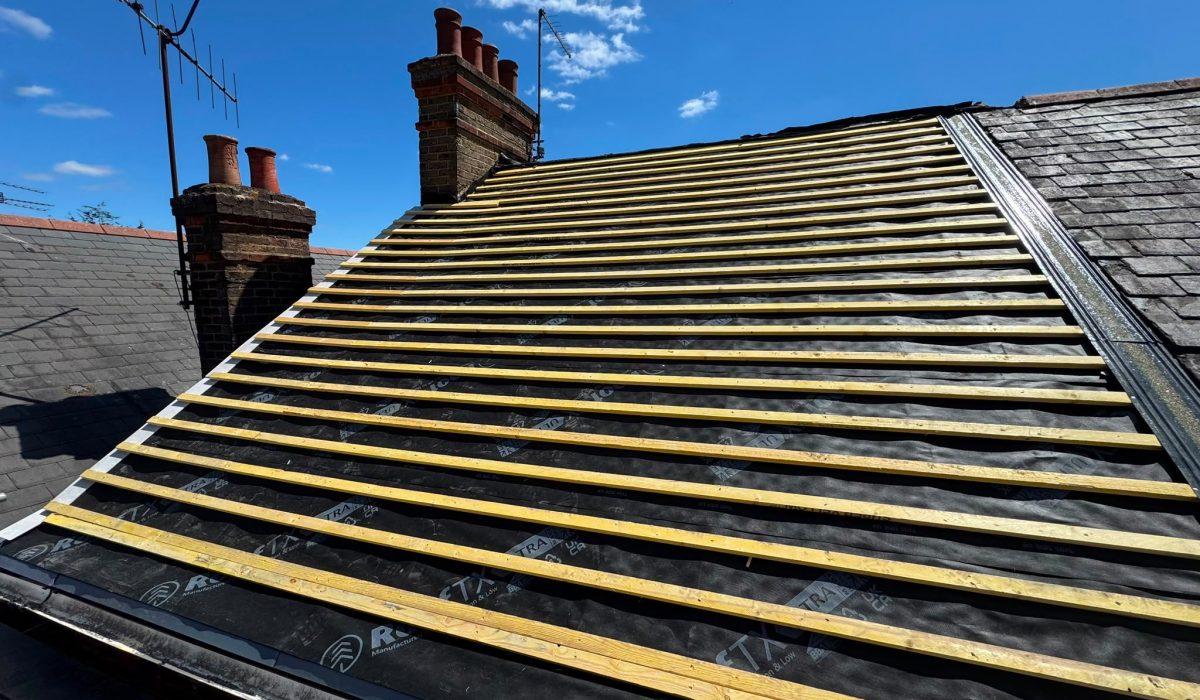
When we strip an older roof, one of the most common discoveries is that there is nothing under the tiles or slates. No felt, no membrane, no second line of defence. It is not a sign of bad workmanship. It is simply that the builders of Victorian and Edwardian houses had no underlay to fit.
Why old roofs have no underlay
Roofing underlay, the waterproof layer fitted between the rafters and the roof covering, did not exist when many London homes were built. Roofs relied on the tiles or slates alone. That works while every tile and slate is in place, but it leaves the house exposed the moment one slips.
What it means for your home
- Any slipped tile or slate becomes a leak. With no membrane underneath, water goes straight into the roof space.
- Wind-driven rain and snow can blow up under the covering and into the loft.
- Dust and debris can fall into the roof space.
- Repairs can only buy time. If the roof has no underlay and the covering is ageing, patching one problem often leads to the next.
We have replaced several roofs where there was no felt whatsoever. One customer had multiple leaks and birds and pests nesting in the roof; the original clay tiles were over 100 years old, and we replaced them with a new Redland 49 tile roof. Another had natural slates delaminating with nail sickness; again, no underlay. See our projects.
What a breathable membrane does
Modern roofs are fitted with a vapour-permeable (breathable) membrane. It sheds any water that gets past the covering, while letting moisture vapour from the house escape, so the roof timbers stay dry. It is laid over the rafters, then new treated timber battens are fixed through it, and the tiles or slates go on top.
Ventilation and dry-fix: the rest of the system
A good re-roof is a system, not just a new covering:
- Eaves-level ventilation using fascia over-vents, to keep air moving through the roof space
- Vent tiles across each roof face where needed
- Dry-ridge, dry-verge and dry-valley systems that replace cracking mortar with mechanical fixings
- Eaves protection trays to direct water into the gutter
- New lead flashings at chimneys and abutments
Is it worth re-roofing an old roof with no underlay?
If the covering is still sound, a repair may be enough for now. But if tiles are crumbling, slates are slipping, or leaks are recurring, re-roofing with a breathable membrane gives much better long-term protection. We give you both options in writing so you can decide. Complete roof replacements come with our 10-year insurance-backed guarantee.
Learn more about new roof installation, tile roofing and slate roofing, or request a free survey.
Underlay FAQs
How can I tell if my roof has underlay?
Look in the loft. If you can see daylight between the tiles or slates, or the undersides of the tiles directly, there is probably no underlay. A roofer can confirm this at a survey.
Do I need underlay for a repair?
No, repairs work with what is there. Underlay is fitted when a roof is stripped and re-laid.
What is the difference between breathable and non-breathable membrane?
A breathable membrane lets moisture vapour escape from the loft while still shedding water, which helps prevent condensation and rot.