

If you are re-roofing a house in South West or South West London, one of the first decisions is the covering. Natural slate and clay tiles are the two classic choices, and both can look right on a period home. Concrete tiles are also common, especially on 20th-century houses. This guide compares them so you can make an informed choice.
Natural slate
Slate is a natural stone split into thin, flat slates. It is dense, strong and very long-lasting, and its fine, flat appearance suits Victorian and Edwardian terraces and villas. Well-laid natural slate can last well beyond a century.
- Lifespan: typically 80 to 150 years or more
- Appearance: fine, flat and dark grey to blue-grey, with variations by quarry
- Maintenance: low, provided the fixings and underlay are sound
- Suits: period homes, conservation areas and premium re-roofs
The weak points on slate roofs are not the slates themselves but the fixings, the underlay and the lead work. Original iron nails corrode (nail sickness), so slates slip, and many older roofs have no underlay at all. A re-slate lets us fit a breathable membrane and new battens, and renew the lead. We often use Spanish Cupa slate. See slate roofing.
Clay tiles
Clay tiles come as traditional plain tiles, which are small and laid in overlapping courses, and as larger interlocking clay tiles. Plain clay tiles give the warm, slightly irregular look of many London streets, and are popular in conservation areas because they match existing roofs.
- Lifespan: typically 50 to 70 years or more
- Appearance: warm reds and browns that weather attractively
- Maintenance: low; old clay can become porous, and nibs can fail
- Suits: period properties, Edwardian houses and arts-and-crafts homes
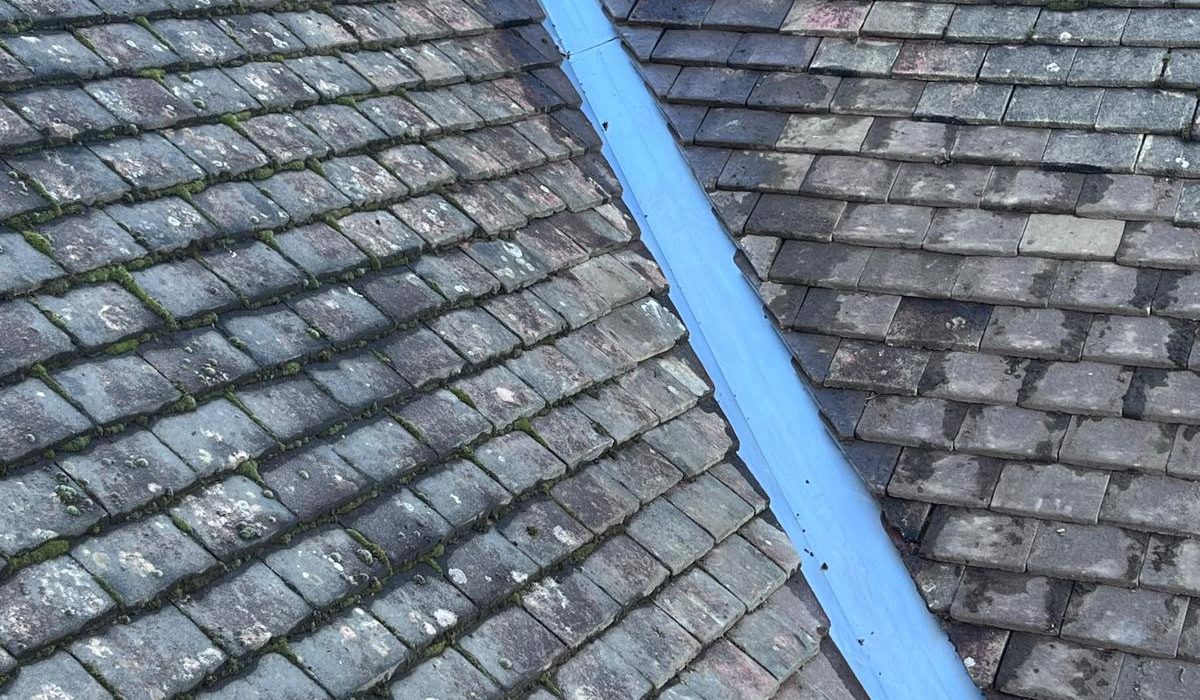
On older roofs the clay tiles can absorb water until the nibs that hang them on the battens break off, which is why tiles start slipping. A recent project of ours involved exactly this: we replaced a roof with Marley Acme plain clay tiles, breathable membrane, vent tiles and a dry-ridge system. See tile roofing.
Concrete tiles
Concrete interlocking tiles, such as the Redland range, are cost-effective, strong and low-maintenance, and suit many 20th-century homes. They typically last 30 to 50 years. They are heavier than slate, so the roof structure should be checked.
Side-by-side comparison
| Covering | Typical lifespan | Look | Best suited to |
|---|---|---|---|
| Natural slate | 80–150+ years | Fine, flat, dark | Victorian and Edwardian homes, premium re-roofs |
| Plain clay tile | 50–70 years | Warm, traditional | Period homes, conservation areas |
| Concrete tile | 30–50 years | Uniform, practical | 20th-century houses, good value |
What affects the cost?
- The covering you choose: natural slate and handmade clay cost more than concrete
- Roof size, pitch and complexity: hips, valleys and dormers add detail
- Condition of the battens and timbers, and whether new underlay is needed
- Lead work at chimneys and abutments
- Scaffolding, access and waste removal
We give an itemised written quote after a survey, so you can see where the money goes.
Conservation areas and matching
In a conservation area the covering often needs to match existing roofs. Tell us your postcode and we will advise on suitable materials and whether the council should be involved. A lot of our work is on period homes, where choosing the right material matters as much as the weatherproofing.
Whichever you choose, get the details right
The covering is only part of a good roof. Make sure your roofer fits a breathable membrane, new treated battens, eaves-level ventilation, dry-fix ridge and verge, and quality lead flashings. Complete roof replacements with us carry a 10-year insurance-backed guarantee. Learn about new roof installation or request a free survey and quote.
Slate vs clay tile FAQs
Which lasts longer, slate or clay?
Natural slate typically lasts longest, often 80 to 150 years or more, against 50 to 70 for clay and 30 to 50 for concrete. In practice the fixings, underlay and lead work often fail before the covering does.
Can I swap slate for tiles to save money?
You can, but on a period home this may change the look of the property and may need consent in a conservation area. Tiles are also usually heavier, so the roof structure should be checked.
Do I need a new roof structure when re-roofing?
Not always. We inspect the rafters and battens during the strip and replace only what is rotten or unsuitable.